MODERN PROCESS MANAGEMENT – A JOINT PROFESSIONAL DAY BY IBM AND BARRÉ
Mózsa Ábel 2026. 10. 20. professional appearance
Process development with an AI agent, modernization on OpenShift, document management with IBM tools – live demos built on real business cases
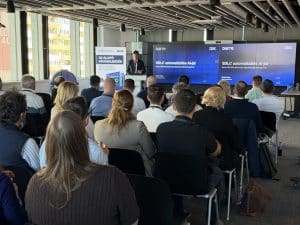
On 16 October 2026, together with IBM, we hosted the Modern Process Management professional day. More than 15 of our clients attended, including a number of large Hungarian companies from the energy and banking sectors. The programme focused on three topics: how AI speeds up the development of process applications, how existing IBM systems can be modernized on OpenShift, and what IBM Content Cortex and AI-based document recognition bring to document management. IBM’s talks presented the product direction; our sessions were live demos built on real business cases.
Process development with an AI agent
IBM’s sessions showed IBM Business Automation Workflow (BAW) working together with watsonx Orchestrate, through a claims-handling case study. Our demo focused on the development side: we extended a purchase request approval process – request entry, budget check, multi-level approval depending on the amount, and ordering – in BAW, using the IBM Bob AI agent.
The demo followed the steps of the software development lifecycle (SDLC). Starting from the specification and the running system, the agent produced the system documentation, identified and fixed a deviation from the specification, designed the tests, and then located and fixed the defect found by the automated end-to-end test. The agent handles most of the steps, while people remain responsible at the decision points: accepting requirements, assessing deviations and approving go-live. Low-code BAW is a good basis for this: processes and user interfaces are visually transparent, so a change proposed by the AI can be reviewed quickly.
Modernization on OpenShift
Content Cortex (FileNet), BAW and Datacap can run on Red Hat OpenShift as well as in traditional installations. Our talk looked at what this means for operations and development. On OpenShift, we describe the target state of the systems, and Operators take care of upgrades, deployments and scaling, so every change becomes cheaper and less risky. Development speeds up too: environments can be created and rolled back quickly, which particularly suits AI agents, as they can try and fix things as many times as needed in disposable environments. A version-controlled target state and platform-level logging also support NIS2 and DORA compliance, and Cloud Pak licences already include the required OpenShift entitlement. We also went through the typical counterarguments: resource requirements, migration risk and operations know-how.
Document management with IBM tools
IBM’s talk presented the IBM Content Cortex strategy: a large share of enterprise content is unstructured, and Content Cortex brings AI agents into the content repository, building on existing FileNet environments without migration. In our demo we followed a contract through its full lifecycle: the agent fills in metadata from the content and cites its sources, answers questions about the document in Hungarian, compares versions, files the document and redacts personal data.
We demonstrated AI-based document recognition on banking cases: customer identification from ID photos, processing of paper-based transfer orders, and recognition and validation of credit card application packages, with clerk review in the Datacap user interface. An invoice processing case study showed how recognition accuracy can be measured and improved field by field.
AI running on-premises
All our demos ran from our own lab: OpenShift, watsonx.ai, Content Cortex, BAW and IBM Bob on a GPU server, with locally hosted language models. This approach matters for organizations whose data cannot leave their own infrastructure.
We would like to thank IBM for co-organizing the event, and our clients for attending and for their questions. We are happy to give anyone interested a live demo in our lab.