
Fluent
Automated, data-driven document generation for enterprise environments, with centrally managed templates, auditable operation and multiple output formats.
In enterprise operations, many documents are created according to the same logic, but with different data: contracts, quotations, certificates, customer notifications, reports, decisions, internal statements, or documents generated at the end of business processes.
Creating these documents manually is time-consuming, prone to errors, and often requires developer or IT support even when only the wording, logic, or appearance of a template needs to be modified. The purpose of template-based document generation is to make it possible to produce these documents automatically, based on predefined templates and structured data.
Fluent by Apryse provides an enterprise-level solution for this: it separates template creation, centralized template management, and the actual document generation process. This helps business teams respond more quickly to changing requirements, while IT can still provide a controlled, integrable, and auditable environment. Based on the uploaded document, the main benefits of Fluent include reduced developer workload, faster template modifications, scalable generation, the option of on-premise or private infrastructure deployment, and support for compliance and auditability requirements.
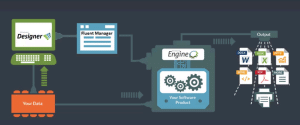
The Fluent platform is built on three main components: Designer, Manager, and Engine. This structure allows business users, administrators, and application developers to work along clearly separated roles and responsibilities.
Designer – template creation in an Office environment
Fluent Designer is a template creation tool that can be used in a Microsoft Office environment. It enables business users to create Word-, Excel-, or PowerPoint-based templates that can include data fields, conditional logic, repeating sections, and more complex document structures. According to Apryse documentation, the purpose of Designer is to allow users to create complex documents, reports, and presentations without extensive coding requirements.
This is especially useful in situations where the content or appearance of a document changes frequently, for example due to regulatory changes, new business rules, modified customer communication, or changes in internal processes.
Manager – centralized template management and version tracking
Fluent Manager is used for the centralized management of templates. Templates can be stored, versioned, assigned to permissions, and released for production use here. This is important because, in an enterprise environment, it is not enough for a template to work technically: it must also be clear who modified it, which version is currently in use, in which environment it is available, and what approval or publishing process it has gone through.
According to Fluent documentation, Manager provides a central location for templates, with access management, versioning, and template promotion capabilities, meaning it supports controlled template management and movement between environments.
Engine – automated document generation
Fluent Engine performs the actual document generation. The enterprise system or business application passes the required data to the Engine and calls it, after which the Engine generates the output document based on the current template version.
The solution can be integrated with existing enterprise systems and workflow solutions through a REST API. According to the uploaded document, the Engine can be deployed as a Java, .NET, or RESTful Engine, and supported output formats include PDF, DOCX, XLSX, and PPTX. Fluent’s official documentation also describes the Engine as the component that combines the template and data to create the required output document.